
Ethiopia’s Next Reform Phase: Expected Tax, Monetary, Financial and Structural Changes
- July 21, 2026
- Posted by: Samson
- Categories: Articles, Economy, Featured Articles
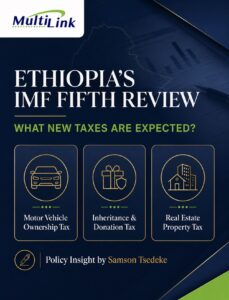
The IMF Fifth Review indicates that Ethiopia is moving from the initial stage of macroeconomic stabilisation into a more difficult implementation phase. The next reforms will affect taxation, foreign exchange, credit, interest rates, fuel pricing, government borrowing, state-owned enterprises and financial-sector competition.
These are programme commitments and IMF-supported policy directions. Some are firm structural benchmarks with deadlines; others are policy recommendations or medium-term intentions. They should not all be treated as enacted law.
1. Tax policy and revenue reforms
1.1 Stronger domestic revenue mobilisation
The government is expected to continue increasing tax revenue as a share of GDP:
Fiscal year
Tax revenue projection
2024/25 actual-7.8% of GDP
2025/26 projection-9.5%
2026/27 projection-10.1%
2027/28 projection-10.5%
2030/31 projection-11.0%
This means the next phase will rely more heavily on taxation and less on central-bank financing or unsustainable borrowing.
The overall direction is clear: broader tax coverage, fewer exemptions, stronger enforcement and more systematic monitoring of incentives.
Source: IMF staff report, Table 1, p. 29 and Table 2b, p. 31; PDF pp. 33 and 35.
1.2 Implementation of income-tax reforms
The government is expected to continue implementing the revised Income Tax Proclamation. The IMF report identifies several components:
- minimum alternative tax;
- changes to withholding taxes;
- adjustments to personal income taxation;
- simplification of the presumptive tax regime;
- changes to corporate income-tax payment arrangements; and
- stronger administration and compliance.
The minimum alternative tax is particularly important. It is intended to ensure that businesses reporting low taxable income or repeated losses still make a minimum contribution based on an alternative tax base.
For businesses, this may mean:
- closer examination of declared turnover and taxable income;
- more rigorous documentation of expenses;
- reduced opportunities to remain outside the formal system;
- higher compliance costs;
- closer reconciliation of tax, customs and banking information; and
- greater exposure to audit where financial reporting is incomplete.
Source: IMF staff report, p. 16; PDF p. 16.
1.3 Reform of investment incentives and tax exemptions
A revised Investment Incentive Regulation has entered into force. The reform is intended to improve the targeting and oversight of tax incentives.
The government is also expected to establish a formal methodology for:
- identifying tax expenditures;
- estimating revenue forgone through exemptions;
- consolidating information across tax categories;
- reporting the fiscal cost of incentives; and
- monitoring whether incentives achieve their stated objectives.
The system is expected to cover:
- value-added tax;
- corporate income tax;
- personal income tax; and
- excise taxes.
This could lead to closer review of:
- customs-duty exemptions;
- income-tax holidays;
- sector-specific privileges;
- project-based import concessions; and
- discretionary investment incentives.
Existing incentives may not automatically be removed. However, investors should expect the government to evaluate their fiscal cost more systematically and to reduce incentives considered poorly targeted or ineffective.
Source: IMF staff report, p. 16 and Table 11, p. 41; PDF pp. 16 and 45.
1.4 Excise-stamp system
The Ministry of Revenue is expected to launch an excise-stamp system by the end of December 2026. This is a new structural benchmark.
The system is intended to improve control over excisable products and reduce:
- under-declaration;
- counterfeit goods;
- illegal production;
- tax leakage;
- smuggling; and
- informal distribution.
The reform will be particularly relevant to producers, importers and distributors of excisable products. Depending on the final rules, affected businesses may need to introduce new product-marking, reporting, inventory-control and verification systems.
Source: IMF staff report, Table 11, p. 42; PDF p. 46.
1.5 Comprehensive tax-compliance programme
The Ministry of Revenue is expected to issue operational directives and instructions for a comprehensive compliance-improvement plan by the end of December 2026.
Likely administrative areas include:
- taxpayer registration;
- risk-based audits;
- collection of tax arrears;
- electronic filing and payment;
- third-party information;
- customs–tax data matching;
- sector-specific compliance programmes; and
- enforcement against non-filers and under-reporting taxpayers.
The report does not provide every operational measure. Therefore, the exact audit rules, penalties and sector priorities cannot yet be confirmed from the reviewed IMF document.
Source: IMF staff report, Table 11, p. 41; PDF p. 45.
1.6 Motor-vehicle ownership tax
The Council of Ministers is expected to submit a proposal for the House of Federation to decide how revenue from the motor-vehicle ownership tax should be assigned between the federal and regional governments.
The structural benchmark has an end-December 2026 target date.
This indicates that motor-vehicle ownership will become a more clearly organised source of recurring tax revenue. The report does not specify the final rates, exemptions, valuation method or collection procedure. Those details cannot yet be confirmed.
Source: IMF staff report, Table 11, p. 42; PDF p. 46.
1.7 Fuel-tax collection at full statutory rates
The Ministry of Finance directed the Ethiopian Customs Commission to collect fuel taxes at full statutory rates and transfer the proceeds to the Treasury.
This marks a move away from using deferred or uncollected fuel taxes as an indirect subsidy.
The likely effects include:
- more transparent fuel taxation;
- higher Treasury revenue;
- reduced hidden fiscal support;
- greater pass-through of fuel costs to users; and
- possible increases in transport and distribution costs.
The supplementary information confirms that this prior action was completed in June 2026.
Source: IMF Supplementary Information, p. 1; PDF p. 127.
2. Fiscal policy and public-expenditure reform
2.1 Continued revenue-led fiscal consolidation
The government is expected to maintain a relatively small fiscal deficit while increasing revenue and protecting priority expenditure.
The fiscal balance, including grants, is projected at:
- negative 2.0% of GDP in 2025/26;
- negative 1.2% in 2026/27;
- negative 1.4% in 2027/28; and
- approximately negative 1.6% over the later projection period.
The government is therefore expected to rely on a combination of:
- increased tax revenue;
- expenditure control;
- improved debt management;
- concessional external financing;
- market-based domestic borrowing; and
- reduction of broad subsidies.
Source: IMF staff report, Table 1, p. 29; PDF p. 33.
2.2 Gradual removal of untargeted fuel subsidies
The FY2026/27 budget caps untargeted fuel subsidies at Birr 20 billion.
This represents a shift from broad price support toward more targeted assistance. The government intends to continue targeted fuel support for public transport while progressively eliminating general fuel subsidies.
Likely effects include:
- more frequent adjustment of retail fuel prices;
- higher transport and logistics costs when international prices rise;
- stronger pass-through to food and consumer prices;
- lower fiscal losses at the Ethiopian Petroleum Supply Enterprise; and
- greater transparency because fuel support is recorded in the budget.
The main policy risk is social impact. Fuel-price increases can affect households even when they do not purchase fuel directly, because transport and distribution costs influence food and other essential prices.
Source: IMF staff report, pp. 20–21; Memorandum of Economic and Financial Policies, relevant fuel-policy commitments; PDF pp. 20–21 and approximately 67–68.
2.3 Stronger protection of priority expenditure
The government is expected to protect expenditure on:
- education;
- health;
- agriculture;
- natural resources;
- productive safety nets; and
- targeted assistance to vulnerable groups.
The FY2026/27 budget allocates Birr 60 billion to the Productive Safety Net Programme, approximately 0.3% of GDP.
Poverty-reducing expenditure is projected at approximately 2.9% of GDP in 2026/27.
The central challenge will be protecting these expenditures while financing fuel-related costs, state-owned enterprise recapitalisation and public debt service.
Source: IMF staff report, p. 21 and Table 2b, p. 31; PDF pp. 21 and 35.
2.4 Improved budget reporting and Treasury control
The government is expected to strengthen:
- regular budget-execution reporting;
- coverage of general government financial statistics;
- monitoring of extrabudgetary entities;
- Treasury Single Account arrangements;
- internal audit;
- administrative transfers between public bodies;
- management of contingency budgets;
- supplementary-budget procedures; and
- fiscal-risk reporting.
These reforms are intended to reduce fragmented government accounts and improve control over public cash.
For government contractors and suppliers, improved Treasury control may eventually produce more predictable payment systems. During the transition, however, stricter commitment controls could slow approvals or restrict unbudgeted expenditure.
Source: IMF staff report, pp. 22–23; PDF pp. 22–23.
3. Foreign-exchange policy reforms
3.1 Continued movement toward a market-determined exchange rate
The National Bank of Ethiopia is expected to continue allowing the exchange rate to respond to market demand and supply.
The IMF does not recommend returning to the previous administratively fixed allocation system. Instead, it expects:
- greater price discovery;
- more competition among banks;
- increased formal-market foreign-exchange supply;
- reduced reliance on the parallel market;
- gradual removal of exchange restrictions; and
- stronger interbank trading.
Exchange-rate flexibility means businesses should not assume that the birr will remain at a fixed nominal rate. Importers, borrowers and investors will need to incorporate exchange-rate scenarios into financial planning.
Source: IMF staff report, pp. 17–19; PDF pp. 17–19.
3.2 Development of an interbank FX market
The National Bank of Ethiopia is expected to develop a roadmap for a deeper interbank foreign-exchange market by the end of September 2026.
The roadmap is expected to include an interdealer trading platform.
A functioning interbank market would allow banks with excess foreign currency to trade with banks facing shortages. This could:
- reduce fragmentation;
- improve market liquidity;
- create more transparent reference rates;
- reduce dependence on direct NBE allocation; and
- support better foreign-exchange risk management.
The reform will take time. The report notes that interbank transactions were still limited and episodic.
Source: IMF staff report, pp. 12 and 17; Table 11, p. 41; PDF pp. 12, 17 and 45.
3.3 Further easing of foreign-exchange restrictions
The authorities had already announced amendments that included:
- allowing service exporters to retain 100% of export proceeds in foreign-exchange accounts for an indefinite period; and
- permitting banks to undertake forward foreign-exchange transactions without prior NBE approval.
Further reforms are expected to address remaining restrictions on current international transactions.
The exact sequence and timing of removing each remaining restriction cannot be confirmed from the report. The IMF stresses gradual implementation to avoid destabilising reserve accumulation.
Source: DSA discussion of FX reforms, p. 10; PDF p. 105.
3.4 Reduction of formal-market transaction costs
The IMF identifies high bank charges, the NBE foreign-exchange commission and possible hidden transaction costs as factors contributing to parallel-market activity.
The reform direction therefore includes:
- reviewing commissions;
- improving transparency of bank charges;
- strengthening competition;
- preventing unfair treatment of customers;
- monitoring bank foreign-exchange positions; and
- reducing incentives for informal transactions.
Businesses could benefit from more transparent pricing, although the removal of administrative privileges may also expose them more directly to market exchange rates.
Source: IMF staff report, pp. 18–19; PDF pp. 18–19.
3.5 Gold-market reform
The National Bank of Ethiopia is expected to develop a plan to reform and eventually exit direct participation in the gold market.
The programme direction includes:
- phasing out premiums paid above international gold prices;
- reducing gold-purchase subsidies;
- improving internal gold-market procedures;
- lowering balance-sheet risks for the NBE;
- reducing incentives for smuggling; and
- directing more foreign-exchange earnings through formal channels.
The NBE recapitalisation plan is expected to incorporate the gradual removal of gold premiums and subsidies.
Source: IMF staff report, pp. 19–20 and Table 11, p. 42; PDF pp. 19–20 and 46.
4. Monetary-policy reforms
4.1 Continued tight monetary policy
The IMF expects the National Bank of Ethiopia to maintain a tight, data-driven monetary stance to control inflation expectations.
The Fifth Review records a 15% policy rate. That is the rate applicable to the reviewed period. The IMF document does not incorporate policy decisions taken after the Board review.
The NBE is expected to tighten policy further if:
- fuel-price increases spread to other prices;
- inflation expectations rise;
- excess banking liquidity remains high;
- private-credit growth becomes excessive; or
- exchange-rate pressure threatens price stability.
Source: IMF staff report, pp. 19–20 and 30; PDF pp. 19–20 and 30.
4.2 Greater use of open-market operations
The NBE is expected to improve monetary control through open-market operations rather than relying mainly on administrative credit restrictions.
The reforms should include:
- regular liquidity-absorbing auctions;
- market-determined auction rates;
- stronger alignment between auction rates and the policy rate;
- improved liquidity forecasting;
- more active interbank money-market trading; and
- better transmission of the policy rate to bank lending and deposit rates.
The IMF observed that open-market operation volumes had declined and that auction cut-off rates were sometimes below the policy rate. This weakened monetary-policy transmission.
Source: IMF staff report, pp. 14–15; PDF pp. 14–15.
4.3 Removal of the private-credit growth cap
The authorities committed to removing the cap on private-credit growth in December 2026.
The expected replacement is a more market-oriented system based on:
- interest rates;
- liquidity management;
- capital requirements;
- bank-specific supervision;
- asset-quality rules;
- borrower-risk assessment; and
- macroprudential controls.
Removing the cap could improve access to credit for productive businesses. It could also increase financial risk if banks expand lending faster than their underwriting and supervisory systems can manage.
Source: IMF staff report, p. 20; PDF p. 20.
4.4 No return to monetary financing
The programme requires the National Bank of Ethiopia to avoid providing new net financing to the government.
The government must increasingly finance itself through:
- tax revenue;
- Treasury bills;
- Treasury bonds;
- concessional external financing; and
- controlled market-based domestic borrowing.
Ending direct monetary financing is essential to reduce inflation. However, market financing may raise government interest costs because Treasury instruments must carry rates attractive to investors.
5. Banking and financial-sector reforms
5.1 Stronger prudential supervision
The National Bank of Ethiopia is expected to continue implementing directives covering:
- risk-based capital adequacy;
- foreign-exchange exposure limits;
- asset classification;
- loan-loss provisioning;
- recovery planning;
- borrower due diligence; and
- bank governance.
It is also expected to develop:
- prompt corrective-action arrangements;
- a bank-resolution framework;
- an integrated macroprudential framework; and
- a stronger financial-sector safety net.
These reforms may require some banks to hold more capital, improve risk systems and recognise problem loans earlier.
Source: IMF staff report, pp. 25 and 31; PDF pp. 25 and 31.
5.2 Closer monitoring of private-credit growth
The report identifies private-credit growth of approximately 50% year-on-year, concentrated particularly in domestic and international trade.
The NBE is expected to examine:
- credit-approval practices;
- borrower financial statements;
- collateral valuation;
- sectoral concentration;
- connected lending;
- foreign-exchange exposure; and
- internal bank governance.
Banks may face stricter requirements for credit documentation and loan classification. Borrowers may consequently experience more demanding due diligence even if the aggregate credit cap is removed.
Source: IMF staff report, pp. 14 and 25; PDF pp. 14 and 25.
5.3 Financial-sector competition and possible foreign-bank entry
The reform direction includes creating a more competitive, market-oriented banking sector. Possible foreign-bank entry is identified as one factor that could increase competition and improve foreign-exchange market functioning.
Potential benefits include:
- new capital;
- trade-finance capacity;
- international banking expertise;
- improved digital services;
- stronger correspondent-banking links; and
- greater competition.
Possible pressures include:
- increased competition for customers and skilled staff;
- stronger compliance standards;
- pressure on smaller domestic banks;
- technology-investment requirements; and
- possible consolidation.
The Fifth Review does not confirm the exact licensing schedule or entry model. These details must be determined by Ethiopian legislation and NBE regulations.
5.4 National Bank of Ethiopia recapitalisation
The NBE and Ministry of Finance are expected to agree on a recapitalisation plan by the end of September 2026.
The plan is expected to address:
- a sustainable equity position;
- positive realised earnings;
- removal of NBE foreign-exchange commission income by the end of June 2028;
- gradual reduction of NBE exposure to public-sector banks;
- phasing out gold-purchase premiums and subsidies; and
- stronger operational independence.
The reform aims to give the NBE the financial capacity to conduct monetary policy without relying on distortionary income sources.
Source: IMF staff report, Table 11, p. 42; PDF p. 46.
5.5 Strengthening NBE governance
The IMF expects further reform of central-bank governance, including appointing independent members to the NBE Board.
Improved governance is intended to:
- strengthen institutional autonomy;
- reduce conflicts of interest;
- improve policy accountability;
- support credible monetary decisions; and
- strengthen oversight of the central bank’s balance sheet and operations.
Source: IMF press release, p. 2; PDF p. 3.
6. Government securities and domestic debt-market reforms
6.1 Market-based Treasury-bill pricing
The Ministry of Finance is expected to end the automatic rollover of Commercial Bank of Ethiopia’s legacy low-interest Treasury bills.
From FY2026/27, maturing instruments are expected to be converted into Treasury bills paying market-determined rates based on comparable primary auctions.
Mandatory rollover is expected to end completely by the end of FY2026/27.
This will:
- reduce financial repression;
- improve pricing of government debt;
- strengthen the monetary-policy transmission mechanism;
- give banks more commercially realistic returns; and
- increase the government’s explicit interest cost.
Source: IMF staff report, Table 11, p. 41; PDF p. 45.
6.2 Treasury-bill and bond issuance directive
The Ministry of Finance and NBE are expected to approve and publish a Treasury Bill and Bond Issuance Directive by the end of October 2026.
The directive should support:
- predictable issuance calendars;
- clearer auction rules;
- development of longer-term government securities;
- better communication with investors;
- improved secondary-market trading; and
- establishment of a market yield curve.
A credible yield curve would help price corporate bonds, bank products and other financial assets.
Source: IMF staff report, Table 11, p. 42; PDF p. 46.
7. State-owned enterprise reforms
7.1 Improved SOE financial reporting
Ethiopian Investment Holdings is expected to publish consolidated financial statements for its state-owned enterprise portfolio.
The original end-December 2025 benchmark was missed. Publication was expected by the end of June 2026 according to the staff report.
Better reporting should provide information on:
- SOE assets and liabilities;
- profitability and losses;
- borrowing;
- government guarantees;
- related-party transactions;
- fiscal transfers; and
- contingent liabilities.
Source: IMF staff report, Table 11, p. 41; PDF p. 45.
7.2 Limits on SOE borrowing
The programme limits non-concessional external borrowing and monitors commercial-bank claims on public enterprises.
The expected direction is:
- stricter approval of new SOE debt;
- borrowing linked to repayment capacity;
- more complete reporting of guarantees;
- closer oversight of bank lending to SOEs; and
- restructuring of financially weak public enterprises.
This could constrain rapid SOE expansion unless projects have credible revenue and financing plans.
7.3 Ethiopian Petroleum Supply Enterprise
The Birr 286 billion recapitalisation is intended to address accumulated losses and legacy fuel-related liabilities.
The reform is accompanied by:
- explicit budget recognition of fuel subsidies;
- collection of statutory fuel taxes;
- stronger financial reporting;
- fuel-price adjustment; and
- gradual elimination of untargeted support.
The recapitalisation transfers part of the enterprise’s financial burden to the government budget. It improves transparency, but it also creates a significant fiscal obligation.
8. Debt-restructuring and borrowing reforms
8.1 Completion of external debt restructuring
Ethiopia is expected to continue negotiations with:
- Official Creditor Committee members;
- other official bilateral creditors;
- external commercial lenders; and
- Eurobond holders.
The objective is to close the external financing gap and restore debt sustainability.
The supplementary information reported that seven of the 14 Official Creditor Committee members had signed bilateral agreements by 25 June 2026. Discussions with Eurobond holders were still continuing.
Source: IMF Supplementary Information, p. 1; PDF p. 127.
8.2 More cautious external borrowing
The programme maintains:
- a zero ceiling on most new non-concessional external borrowing;
- a present-value ceiling on new external debt;
- reporting requirements for SOEs and government guarantees; and
- programme-specific exceptions, including the defined Koysha dam limit.
Future projects will increasingly be assessed against:
- expected economic returns;
- foreign-exchange earnings;
- debt-service capacity;
- concessionality;
- fiscal risks; and
- compatibility with the IMF borrowing plan.
8.3 Current debt position
The Debt Sustainability Analysis continues to classify Ethiopia as being in debt distress.
It estimates that approximately US$3.5 billion in debt relief is required over 2024/25–2027/28 to close the programme-period financing gap.
Debt treatment was not complete at the report date. Therefore, declining debt-to-GDP projections should not be interpreted as confirmation that the debt problem has already been resolved.
Source: DSA, pp. 1 and 20; PDF pp. 96 and 115.
9. Private-sector and investment reforms
The authorities are expected to continue public–private dialogue focused on:
- tax administration;
- customs;
- investment protection;
- regulatory stability;
- business licensing;
- market access; and
- private-sector constraints.
Additional reform areas include:
- logistics-sector liberalisation;
- financial-sector competition;
- World Trade Organization accession;
- implementation of the African Continental Free Trade Area;
- investment-incentive reform; and
- improved customs administration.
The direction is favourable to private-sector participation. Nevertheless, investors should distinguish announced reforms from measures already enacted and operational.
Source: IMF staff report, p. 26 and Annex I, pp. 43–44; PDF pp. 26 and 47–48.
Overall expectation
Ethiopia’s next reform stage will be characterised by:
- broader and more strictly administered taxation;
- reduced tax exemptions;
- more market-based fuel pricing;
- a flexible exchange rate;
- deeper interbank FX trading;
- tighter monetary control;
- eventual removal of the credit-growth cap;
- stronger bank supervision;
- possible foreign-bank competition;
- market-based government borrowing;
- NBE and SOE recapitalisation;
- greater SOE transparency; and
- continued external debt restructuring.
The reforms could improve stability, transparency and private investment over the medium term. In the short term, however, businesses and households should prepare for higher compliance requirements, market-based interest rates, exchange-rate movement, fuel-price adjustment and closer financial supervision.