
How Indebted Is Ethiopia? The 40.4% Headline and the Reality Behind It
- August 1, 2026
- Posted by: Samson
- Categories: Business News, Economy, Featured Articles
By Samson Tsedeke
Founder, Managing Director and Lead Consultant, MultiLink Consulting
IMF DataMapper (2026); IMF Country Report No. 26/174; World Bank–IMF Debt Sustainability Analysis.
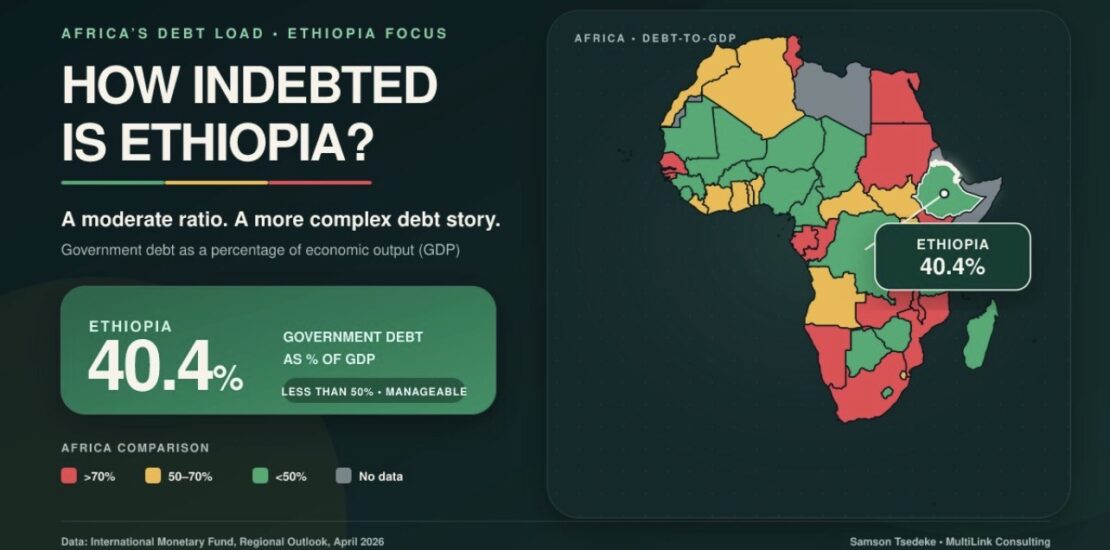
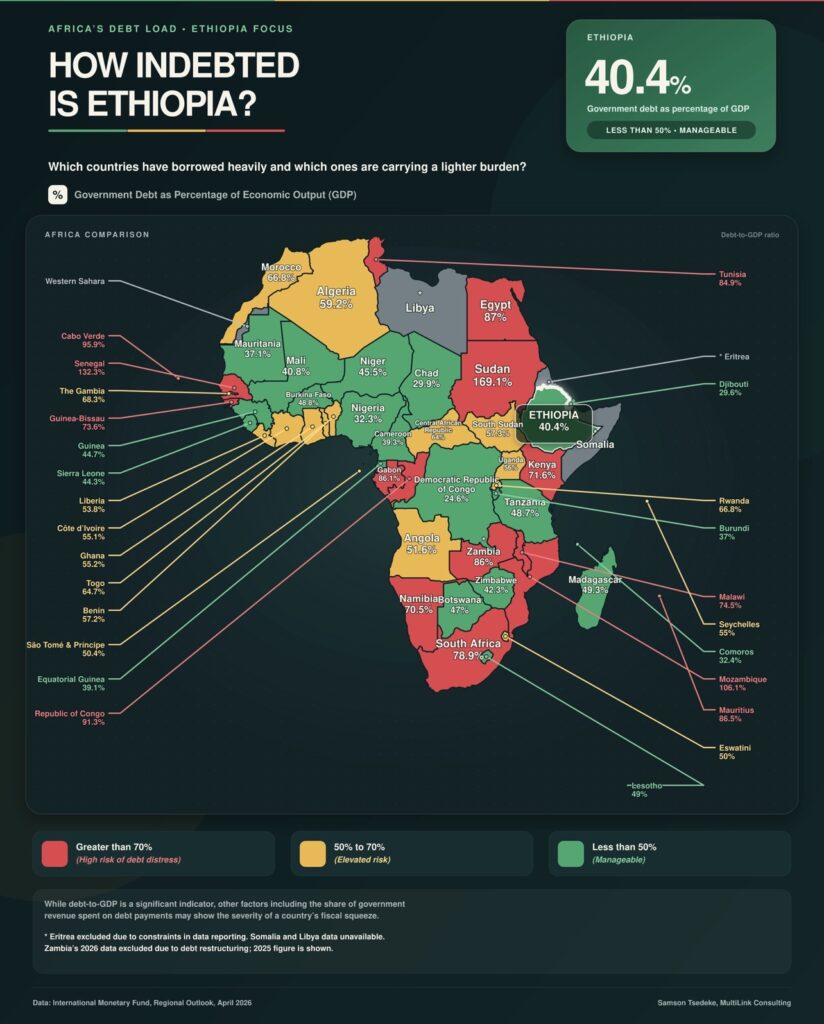
The accompanying map appears reassuring for Ethiopia. With government debt estimated at 40.4% of GDP, the country sits below the 50% threshold used in the graphic and carries a lower headline ratio than many major African economies. The figure is consistent with the IMF’s 2026 estimate for general government gross debt. IMF DataMapper
But does this mean Ethiopia’s debt is manageable?
The honest answer is more complicated.
Two statements can be true at the same time:
- Ethiopia’s total government debt is comparatively moderate when measured against GDP.
- Ethiopia continues to face serious external debt-servicing pressure and remains in debt distress pending completion of its restructuring process.
This distinction matters. A debt-to-GDP ratio measures the size of the debt stock relative to the economy. It does not, on its own, show whether a government has enough foreign exchange, export earnings or fiscal revenue to meet payments when they fall due.
A moderate debt stock can still create severe repayment pressure
Debt sustainability depends on more than the amount borrowed. It also depends on:
- The currency in which the debt must be repaid
- Interest rates and repayment periods
- The concentration of maturities
- Government revenue available for debt service
- Export earnings and foreign-exchange reserves
- State-owned enterprise liabilities and government guarantees
- The country’s access to refinancing and concessional funding
This is particularly important for Ethiopia. Much of the country’s external debt must ultimately be serviced using foreign currency. Ethiopia may generate GDP in birr, but external creditors cannot normally be repaid in birr. Export performance, remittances, reserves and access to external finance therefore become critical.
The IMF’s June 2026 Debt Sustainability Analysis assessed Ethiopia’s debt as unsustainable under the pre-restructuring payment schedule. It identified persistent breaches of the debt-service-to-exports and debt-service-to-government-revenue indicators. The IMF also classified Ethiopia as being in external debt distress following the missed Eurobond interest payment in December 2023. IMF Country Report No. 26/174
Therefore, the green colour on the map should not be interpreted as an official declaration that Ethiopia has no debt problem. It shows a relatively moderate debt stock. It does not represent the IMF’s formal debt-sustainability rating.
Why has the debt-to-GDP ratio declined?
There has nevertheless been meaningful improvement in Ethiopia’s headline debt ratio.
A joint World Bank–IMF analysis reported that Ethiopia’s public and publicly guaranteed debt declined from 48.9% of GDP at the end of 2021/22 to 34.8% at the end of June 2024. The analysis attributed the reduction mainly to limited external disbursements and strong nominal GDP growth. External and domestic debt both grew more slowly than nominal GDP during that period. World Bank–IMF Debt Sustainability Analysis
This reduction is significant, but the composition and repayment schedule remain important. A country can record a falling debt-to-GDP ratio while still experiencing difficulty meeting near-term foreign-currency obligations.
Debt stock indicates how much is owed. Debt service indicates when the money must be paid and whether the resources are available.
Restructuring is therefore central
Ethiopia’s debt outlook depends heavily on completing the restructuring process with official and commercial creditors.
The IMF reported in July 2026 that progress had been made under the G20 Common Framework. It also stressed that completing the restructuring, maintaining prudent borrowing and developing a liquid local-currency government securities market would be important for restoring sustainability and limiting future vulnerabilities. IMF Fifth ECF Review
Under the illustrative post-restructuring scenario presented in the IMF’s June 2026 report, Ethiopia’s risk classification is expected to improve to moderate risk of debt distress by the end of the IMF-supported programme in July 2028. This outcome is conditional. It depends on successfully completing the debt treatment, maintaining macroeconomic reforms, improving exports and avoiding imprudent new borrowing.
What should Ethiopia prioritise?
The policy discussion should move beyond asking whether 40.4% is high or low. Ethiopia should focus on the quality, cost and productivity of its debt.
Five priorities stand out.
First, complete debt restructuring.
Uncertainty regarding creditor treatment affects market confidence, access to financing and the government’s medium-term fiscal planning.
Second, strengthen domestic revenue mobilisation.
A government with a relatively low debt ratio can still experience distress if its revenue base is too narrow. Debt-service-to-revenue is therefore as important as debt-to-GDP.
Third, expand exports and foreign-exchange earnings.
Stronger exports improve the country’s ability to service foreign-currency debt without compressing essential imports.
Fourth, deepen the domestic government securities market.
A transparent and competitive local-currency debt market can reduce reliance on foreign-currency borrowing. It must, however, be developed carefully to avoid crowding productive private-sector lending out of the financial system.
Fifth, strengthen oversight of state-owned enterprises.
SOE borrowing, guarantees and contingent liabilities must be incorporated into fiscal-risk monitoring. Obligations that are not initially recorded as central-government debt can eventually become public liabilities.
The correct conclusion
Ethiopia is not among Africa’s most heavily indebted countries when debt is measured simply as a percentage of GDP. The 40.4% ratio provides evidence of a comparatively moderate debt stock.
But the ratio should not be confused with debt sustainability.
A more accurate conclusion is this:
Ethiopia’s debt stock is moderate relative to the size of its economy, while its external debt-service position remains distressed under the pre-restructuring schedule.
Completion of the restructuring process, stronger exports, improved revenue mobilisation, disciplined borrowing and better management of public-sector liabilities will determine whether the favourable headline ratio translates into genuine and durable fiscal stability.
The debate should therefore move from “How much debt does Ethiopia have?” to a more useful question:
Can Ethiopia service its debt on time, in the required currency, without undermining investment, essential imports and long-term development?
That is the real test of debt sustainability.
#Ethiopia #PublicDebt #DebtSustainability #AfricanEconomy #EconomicReform #Investment #FiscalPolicy #MultiLinkConsulting