
Opinion | The Afreximbank–Fitch Rift Signals a Larger Problem in How Africa Is Rated — Ethiopia Included
- January 31, 2026
- Posted by: Samson
- Categories: Articles, Featured Articles
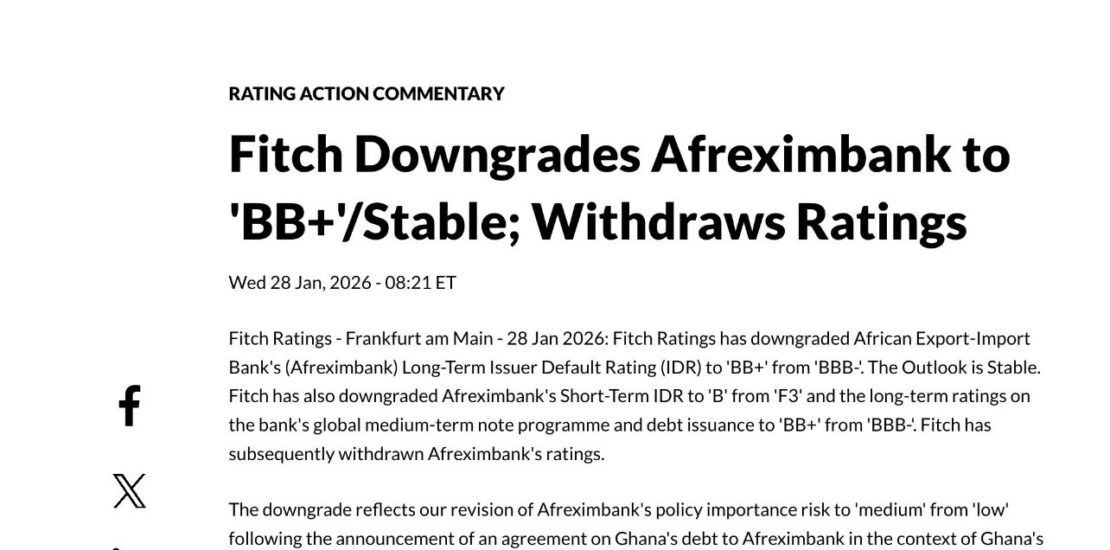
The recent decision by the African Export–Import Bank (Afreximbank) to terminate its credit-rating relationship with Fitch Ratings is more than a disagreement between a multilateral lender and a global agency. It exposes a structural imbalance in how African institutions—and African sovereigns—are assessed in international financial markets. Ethiopia’s ongoing struggle to secure a fair and forward-looking sovereign rating sits squarely within this broader pattern.
In late January 2026, Afreximbank announced that it would no longer participate in Fitch’s rating process. The Bank argued that Fitch’s downgrade did not appropriately reflect its mandate, its preferred-creditor protections, and the institutional guarantees provided by African shareholder governments. The African Union’s African Peer Review Mechanism reinforced this position, cautioning that unsolicited ratings issued without the Bank’s cooperation risk “misinforming investors.” The message was clear: Africa is questioning the neutrality of the global credit-rating architecture.
This episode matters because credit ratings are not simply technical assessments—they shape borrowing costs, investor perceptions, and the cost of development capital. When methodologies fail to capture the institutional realities of African multilaterals, the cost is borne by countries and private actors across the continent.
Ethiopia offers a compelling parallel. Over the past several years, Ethiopia has faced multiple sovereign rating downgrades driven by macroeconomic instability, debt-servicing pressures, and foreign-exchange shortages. These assessments are grounded in measurable indicators, yet they often overlook structural factors that provide resilience—ongoing reforms, state-backed institutional frameworks, and Africa-wide political guarantees that do not always fit neatly within global rating templates. Even as Ethiopia engages creditors, advances structural reforms, and builds the foundation for a capital market, rating upgrades have not followed at the same pace.
The underlying issue is methodological. Global rating agencies place heavy weight on sovereign-risk factors—political risk, conflict exposure, external financing capacity, fiscal pressures—and Africa systematically scores low on these indicators. This does not mean the assessments are incorrect; the risks are real. But the weighting system itself is inherited from a global financial architecture where African institutions are structurally disadvantaged. The Afreximbank case simply brings this tension into sharper focus.
The implications for Ethiopia are tangible. A conservative rating raises the cost of sovereign borrowing, constrains private-sector financing, and limits access to trade credit and insurance. It affects everything from infrastructure financing to the cost of importing essential goods. Investors rely on these ratings, even when they understate a country’s reform trajectory.
There is no easy solution, but the way forward is clearer after the Afreximbank–Fitch rupture.
First, African institutions—including sovereign governments—must strengthen the articulation of their reform narratives. Transparent disclosure, data-rich reporting, and consistent communication with rating agencies reduce informational asymmetry.
Second, Africa should push—through AU platforms—for more contextualized methodologies that better incorporate regional institutional protections, multilateral support frameworks, and lender-of-last-resort mechanisms that are unique to the continent.
Third, Africa needs credible alternatives. Regional rating agencies, stronger AU-aligned financial reporting frameworks, and peer-review mechanisms can help rebalance the narrative and provide investors with complementary assessments.
Afreximbank’s decision is not a rejection of global standards. It is a demand for fairness and methodological relevance. Ethiopia, navigating a delicate mix of macroeconomic adjustment and structural reform, stands to benefit from a more balanced and context-aware global rating system. Until then, both African sovereigns and African multilaterals will continue to operate in an environment where risk is often overstated and reform is frequently under-acknowledged.
The Afreximbank episode is a reminder that Africa must not only fix fundamentals—it must also shape the global framework through which those fundamentals are judged.
Samson Tsedeke, Samson@multilinkconsult.com